
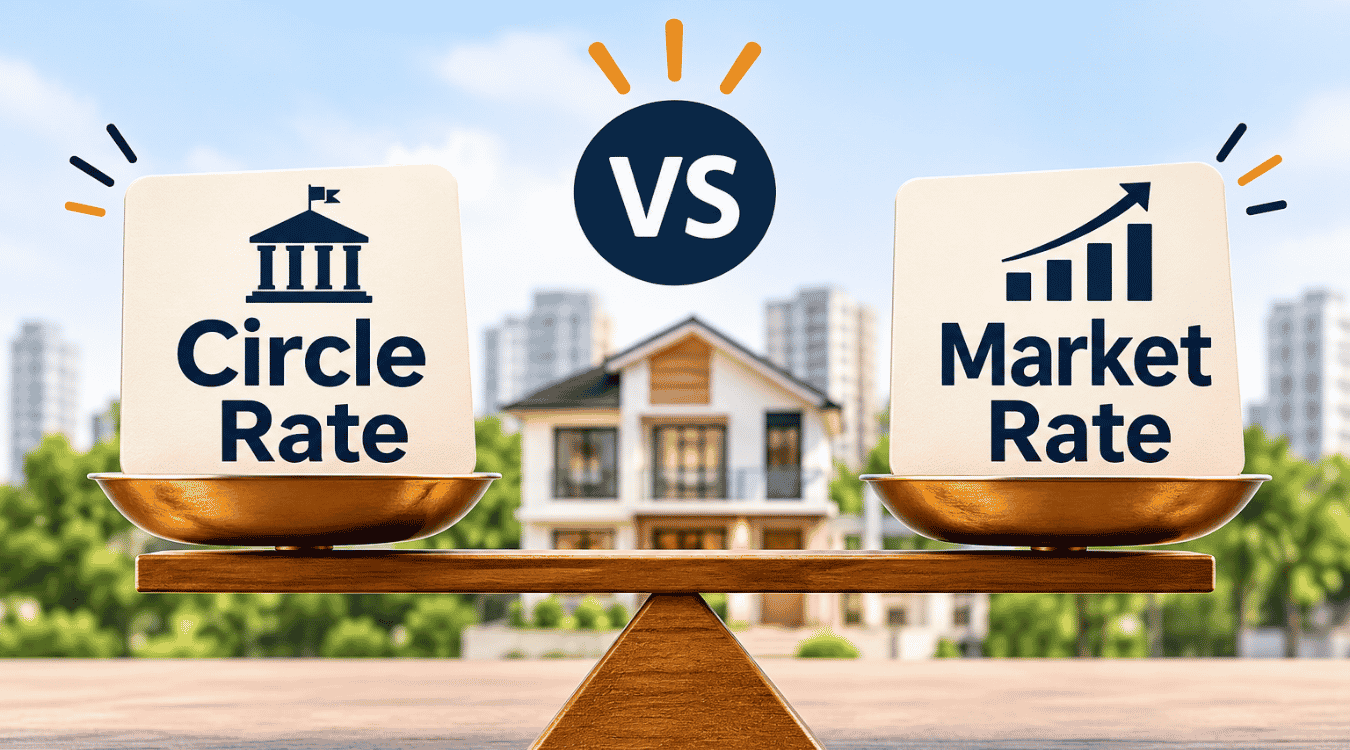
Buying or selling a property involves more than just agreeing on a price. One of the most important things every property buyer and seller should understand is the difference between Circle Rate vs Market Rate. These two terms play a significant role in property valuation, stamp duty calculation, registration charges, and real estate transactions.
Whether you are planning to purchase a flat, sell a residential property, or invest in land, understanding Circle Rate vs Market Rate can help you make informed financial decisions and avoid unexpected expenses.
In India, circle rates are determined by the respective state governments, while market rates depend on property demand, location, infrastructure, and other market factors.
In this blog, we will explain Circle Rate vs Market Rate, their differences, how they are calculated, and why they matter when buying or selling property.
What Is Circle Rate?
Circle Rate is the minimum property value determined by the state government for a particular area. It is also known as the guideline value, ready reckoner rate, or collector rate in different parts of India.
The government uses circle rates as a reference for calculating stamp duty and property registration charges.
Circle rates vary depending on several factors, including:
- Location and neighbourhood.
- Type of property (residential, commercial, or land).
- Property usage and category.
- Road connectivity and infrastructure.
- Property age and construction type.
- Floor level and other applicable valuation factors.
For example, if the government has fixed the circle rate of a residential property at ₹5,000 per square foot, this rate will be used as the applicable valuation benchmark for registration, subject to the relevant state rules.
Why is Circle Rate important?
- Helps determine the minimum government-assessed property value.
- Acts as a benchmark for stamp duty calculation.
- Helps calculate property registration charges.
- Promotes transparency in property transactions.
- Helps reduce property undervaluation in official documents.
Circle Rate vs Market Rate: Key Differences
Understanding Circle Rate vs Market Rate is essential because both values serve different purposes in a real estate transaction.
Here is a quick comparison:
| Basis | Circle Rate | Market Rate |
|---|---|---|
| Meaning | Government-fixed minimum valuation benchmark | Current estimated buying and selling price |
| Determined by | State government | Market demand and supply |
| Price changes | Revised periodically by authorities | Can change frequently |
| Main purpose | Stamp duty and registration valuation | Property buying and selling |
| Influencing factors | Government valuation guidelines | Location, demand, amenities and condition |
| Negotiation | Not generally negotiable as a government rate | Negotiable between buyer and seller |
| Value | May be lower or higher than market value | Reflects prevailing market conditions |
The main difference in Circle Rate vs Market Rate is that circle rate is a government-determined benchmark, whereas market rate reflects the property’s prevailing commercial value

Circle Rate vs Market Rate: What Happens When They Are Different?
In most property transactions, the circle rate and market rate may not be the same.
There are three common situations:
1. Market Rate Is Higher Than Circle Rate
This is a common situation in high-demand locations.
For example:
- Circle Rate: ₹5,000 per sq. ft.
- Market Rate: ₹7,500 per sq. ft.
- Actual Sale Price: ₹7,500 per sq. ft.
In such cases, stamp duty is generally calculated using the higher applicable value, subject to state-specific rules.
2. Market Rate Is Lower Than Circle Rate
Sometimes, due to low demand, poor property conditions, or declining local market activity, the actual market value may be lower than the government circle rate.
For example:
- Circle Rate: ₹6,000 per sq. ft.
- Market Rate: ₹5,000 per sq. ft.
- Actual Sale Price: ₹5,000 per sq. ft.
Even if the buyer purchases the property at a lower price, stamp duty may be calculated using the higher government-assessed value, depending on the applicable state rules and valuation provisions.
3. Market Rate and Circle Rate Are the Same
In some locations, both values may be similar.
For example:
- Circle Rate: ₹5,500 per sq. ft.
- Market Rate: ₹5,500 per sq. ft.
- Actual Sale Price: ₹5,500 per sq. ft.
This makes property valuation and registration calculations relatively straightforward.
How Does Circle Rate Affect Stamp Duty and Property Registration?
One of the biggest reasons buyers should understand Circle Rate vs Market Rate is their impact on stamp duty and registration expenses.
In India, stamp duty is generally calculated on the higher of the declared transaction value and the applicable government-assessed value, subject to the relevant state laws.
For example:
Suppose you purchase a flat with the following details:
- Property area: 1,000 sq. ft.
- Circle rate: ₹5,000 per sq. ft.
- Market purchase price: ₹7,000 per sq. ft.
The calculations would be:
| Particulars | Amount |
|---|---|
| Circle Rate Value | ₹50,00,000 |
| Actual Purchase Price | ₹70,00,000 |
| Applicable Valuation Benchmark | ₹70,00,000 |
Stamp duty and registration charges would generally be calculated using ₹70 lakh as the valuation base, subject to the applicable state rules.
Important: Stamp duty rates, valuation methods, exemptions, and registration charges differ across Indian states. Always verify the latest rules with the relevant registration authority before completing a property transaction.
Why Should Property Buyers and Sellers Understand Circle Rate vs Market Rate?
Knowing Circle Rate vs Market Rate can help both buyers and sellers avoid common property transaction mistakes.
For Buyers:
- Estimate stamp duty and registration expenses.
- Understand whether the asking price is reasonable.
- Compare government valuation with actual market value.
- Avoid unexpected registration costs.
- Make better property investment decisions.
For Sellers: - Set a realistic selling price.
- Understand the property’s government-assessed value.
- Negotiate confidently with potential buyers.
- Plan the financial aspects of the sale.
- Avoid complications during property registration.
A clear understanding of Circle Rate vs Market Rate helps ensure better financial planning and smoother property transactions.
Common Mistakes to Avoid When Comparing Circle Rate vs Market Rate
Even experienced property buyers can overlook important details while comparing property values.
Here are some common mistakes to avoid:
- Assuming circle rate and market rate are always the same.
- Calculating stamp duty only on the circle rate.
- Ignoring the property’s actual condition and location.
- Depending entirely on online property listings for market valuation.
- Not checking the latest government-notified rates.
- Ignoring additional registration and transaction expenses.
- Not consulting a property or legal professional before finalising the deal.
Remember, the lowest property price does not always mean the best investment. Proper valuation and documentation are equally important.
Frequently Asked Questions (FAQs)
1. Is Circle Rate always lower than Market Rate?
No. Circle Rate is not always lower than Market Rate. Depending on the location and market conditions, it can be lower than, equal to, or higher than the actual market value.
2. What is a circle rate?
Circle rate is the minimum property valuation set by the state government for calculating stamp duty and property registration charges.
3. Can I sell my property above circle rate?
Yes. You can sell your property above the circle rate. The final selling price depends on market demand, property location, condition, and buyer negotiations.
4.Does market rate affect property registration?
Yes. The market rate can affect the declared transaction value. If it is higher than the applicable circle rate, it may become the valuation basis for stamp duty and registration calculations.
Leave a Reply